Centralized Compliance for Multi-Site Organizations
Compliance Management, Organisational Visibility, Health and Safety Governance
Can You See Your Entire Organisation From One Place?
For multi-site organisations, the real compliance challenge is no longer knowing what should be happening. It is having a defensible, current view of what is happening across every branch, warehouse, distribution centre and office – without relying on spreadsheets, email trails and last‑minute follow‑ups.
From Fragmented Updates to a Single Compliance Position
In many organisations, a simple management question – “What is our compliance position across the entire organisation right now?” – still triggers a manual exercise. Branches are asked for updates, spreadsheets are consolidated, emails are checked, and someone at head office becomes the bottleneck for turning scattered inputs into a single report. Time is spent assembling information, not understanding risk.
A central electronic compliance system changes that dynamic. Instead of information being recreated for each report, it is captured once at source and made available through structured views. Modern platforms, as industry research shows, are moving from passive systems of record to active, integrated compliance ecosystems that support real-time oversight and evidence-based decision-making (Forrester, StarCompliance 2026 studies).
Building the System Around Your Organisational Hierarchy
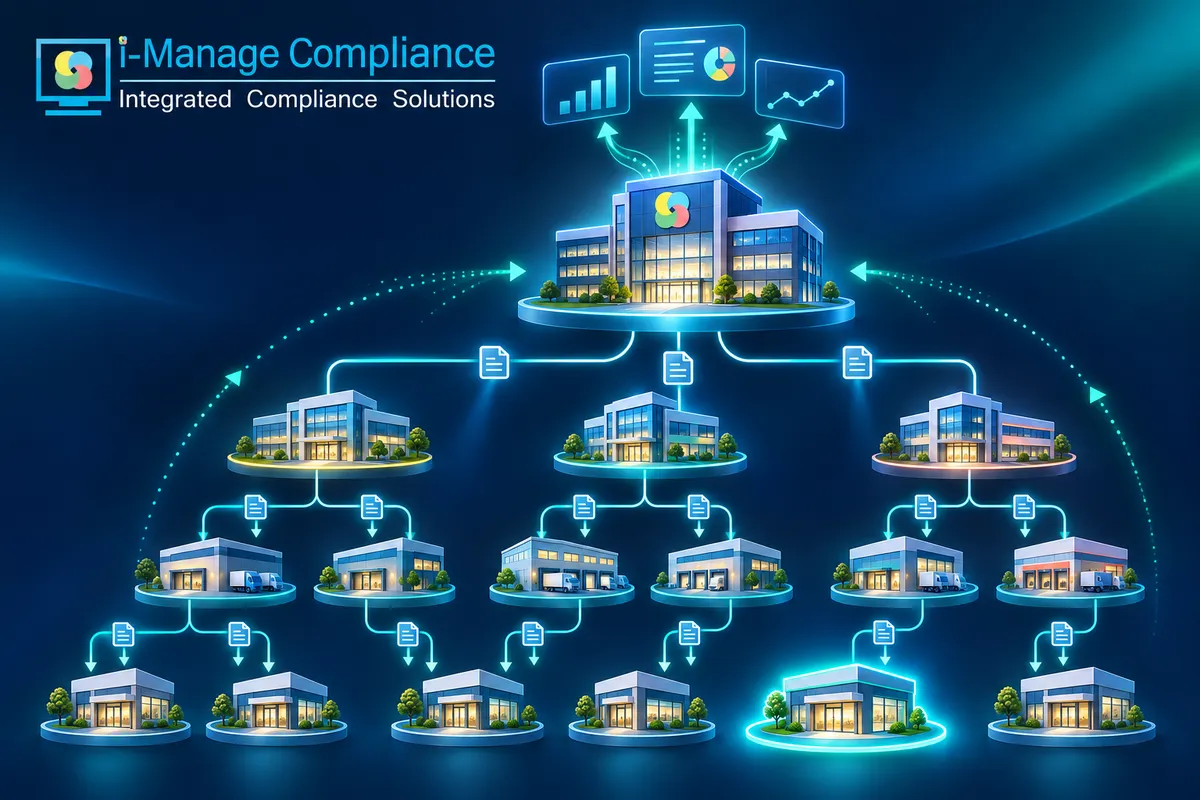
Central visibility only becomes meaningful if the electronic compliance system mirrors the real organisation. That means structuring the system to reflect how your business actually operates – group, divisions, regions, operational clusters, branches, warehouses, buildings and departments – not a generic template that ignores operational reality.
The organisation or group
Divisions or business units
Regions or operational zones
Sites – branches, warehouses, distribution centres, offices
Departments, production areas or other local groupings
When i‑Manage Compliance is configured around this hierarchy, authorised users can navigate from the group level down to a single site, and back again, without losing context. An incident, inspection or document is no longer a standalone record; it is visible in relation to the branch, region and organisation it affects.
Different Roles, Different Levels of Visibility
Senior leaders, regional managers and site teams do not need the same view. A branch manager typically focuses on one location. A regional or operations manager needs to compare multiple branches. The health and safety team requires an organisation‑wide compliance position, while executives and boards often want high‑level indicators with the ability to drill down when required.
A structured electronic compliance system supports this by filtering information according to the user’s authority and the organisational hierarchy. The same underlying data can be viewed:
By organisation, division, region or branch
By building, warehouse, department or operational grouping
By activity type, risk, incident category or time period
This allows management to investigate a specific site while still understanding how it compares to similar locations and to the organisation as a whole.

Role-based dashboards allow managers to move from branch-level detail to group-level trends in seconds.
Incident Reporting: From Local Records to Group Insight
Incident reporting is where fragmented systems expose their limitations most quickly. With hundreds of locations, asking each branch for its own report leads to duplicated effort, inconsistent categories and slow consolidation. The compliance function becomes an information chaser rather than a risk manager.
In a central electronic compliance system such as i‑Manage Compliance, incident records are captured once against the correct site, using an agreed structure and standard categories. Authorised users can then select:
A single branch, a region, a division or the full organisation
Specific incident types, severities or root causes
Defined reporting periods aligned with internal or external requirements
The same captured data supports branch‑level learning, regional benchmarking and group‑level reporting without repeated collection. This aligns with broader market trends where compliance platforms are expected to act as evidence systems, not just storage tools, providing traceable, time‑bound records for audits and investigations.
Central Visibility for Better Oversight – Not Central Control
When information from every site is visible in one place, patterns emerge that individual branches may not see. A single slip‑and‑trip incident at one store may appear isolated. Viewed across 500 branches, the same incident type may indicate a systemic housekeeping or design issue that warrants group‑level intervention.
Overdue corrective actions and recurring non‑conformances
Incomplete inspections or missed statutory checks
Expired appointments, training gaps and missing documentation
Unresolved equipment defects and recurring hazards
Central visibility supports management oversight; it does not replace local accountability. Branch managers remain responsible for implementation. The role of head office and senior management is to identify emerging risk, allocate support and ensure that corrective actions are completed and evidenced across the network.
Document Consistency and Top‑Down Standardisation
Multi‑branch organisations often discover during audits that different sites are using different versions of policies, procedures and forms. Without a central structure, document control becomes a matter of who last received an email attachment or printed a checklist.
By linking documents to the organisational hierarchy, i‑Manage Compliance allows company‑level standards to be issued once and applied consistently across applicable sites, while still enabling regional or site‑specific requirements where justified. This supports controlled management of:
Policies, standard operating procedures and risk assessment formats
Inspection templates, approved forms and emergency requirements
Induction content and document revisions across multiple sites
Onboarding New Branches Without Rebuilding Compliance
Opening a new branch should not require recreating your compliance framework from scratch. In a central electronic compliance system, the new site is added into the existing hierarchy and automatically inherits applicable company and regional requirements, subject to your governance rules and approvals.
Implementation teams can then focus on what is genuinely local – specific risks, emergency arrangements, building details, equipment, local contractors and municipal or client conditions – rather than rebuilding standard content. This supports faster, more consistent onboarding while still respecting local realities.
Real‑Time Visibility Depends on Data Quality
Modern compliance platforms increasingly offer near real‑time dashboards and alerts. However, “real‑time” does not mean “automatically correct”. A system can only display what has been captured, maintained and approved. If an incident is never recorded, an action is not closed, or an appointment is not updated, the central view remains incomplete – regardless of technology.
Clear branch responsibilities and ownership of records
Defined data‑capture processes and consistent categories
Current employee and organisational information
Appropriate access controls, management follow‑up and periodic data quality review
i‑Manage Compliance is built on this principle: technology improves visibility, accountability and traceability, but it does not remove the need for disciplined operational follow‑through.
One Organisation, Multiple Views – From Branch to Board
The real value of a central electronic compliance system is not that everything is stored in one place, but that the same information can support different levels of responsibility and oversight. A branch manager can manage local actions. A regional manager can compare trends across sites. Head office can see the organisation as a whole. Executive leadership can review key indicators, patterns and exceptions with the ability to drill into the underlying evidence when required.
i‑Manage Compliance is designed to give organisations this structured visibility – turning compliance from a periodic, paper‑driven exercise into a live operational function with clear ownership, traceable actions and defensible audit trails across every branch, warehouse and distribution centre.
If your organisation needs to understand the compliance position of a single site and the entire group without collecting the information again, the next step is a practical conversation. Discuss how your organisational hierarchy can be represented electronically, how visibility can be structured for different management levels, and how i‑Manage Compliance can support clearer oversight, stronger accountability and more consistent compliance performance across your operations.