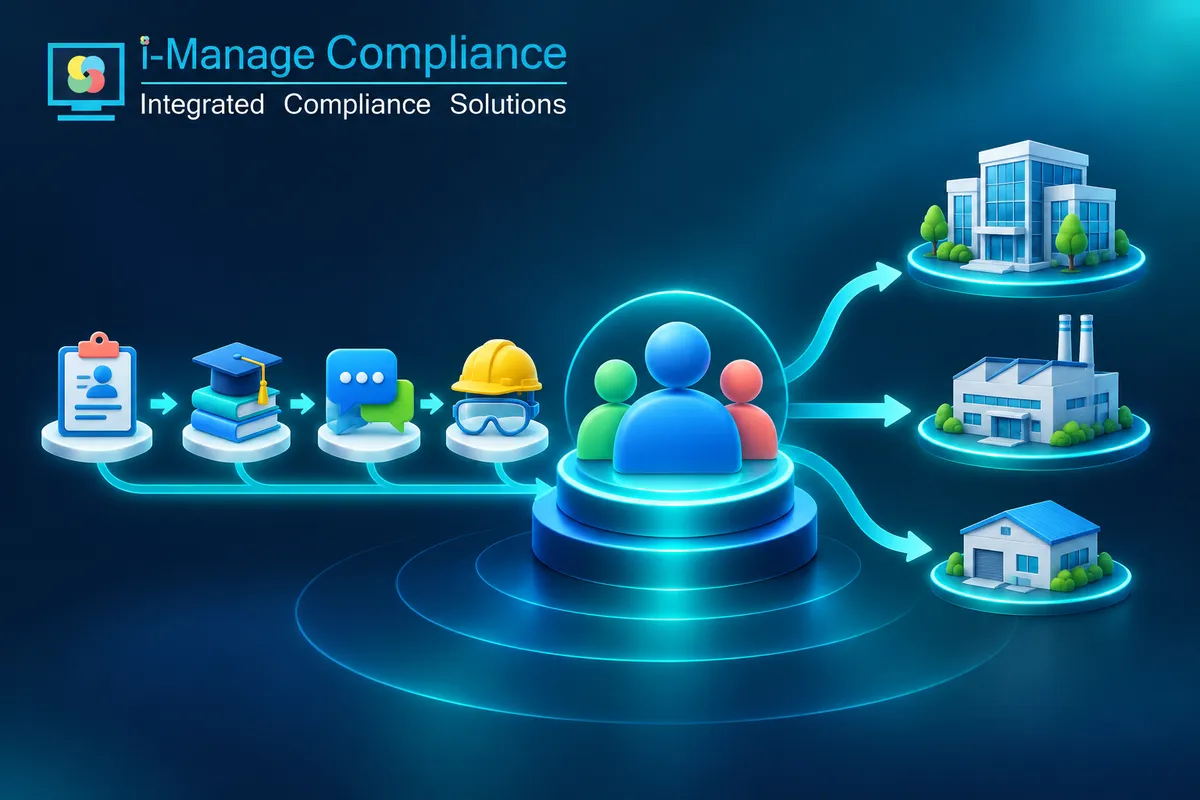
Effective Compliance Management with Role-Based Structures
Compliance Management, Role-Based Structures, Multi-Branch Governance
Why Roles Are the Foundation of an Effective Compliance Management System
In complex, multi-branch organisations, the real compliance challenge is not drafting another policy. It is ensuring that the right requirements reach the right people, in the right place, at the right time — and that management can see this happening with confidence.
Roles: The Operational Backbone of Compliance
For organisations where compliance is operationally significant, roles are not an administrative label. They are the structural link between people, work and risk. A role-based compliance management system allows you to define which inductions, training, documentation, and controls are required for a type of work, and then apply that consistently to every person who performs it.
In practice, a role is far more than a job title. In an electronic system such as i‑Manage Compliance, a role groups employees who share similar responsibilities, exposures and compliance obligations. For example, a “warehouse operator” role might be connected to:
General company and site-specific inductions
Task-relevant training and refresher assessments
Toolbox talks or communication sessions they must attend
Required PPE, procedures, forms and emergency information
Instead of assigning every requirement to each employee manually, the organisation defines the common requirements once at role level, then allocates people to that role. When someone joins, moves branches or changes position, the system can identify what now applies and where gaps exist. The result is repeatable structure rather than ad-hoc administration.
The Multi-Branch Challenge: Same Work, Different Labels
Multi-branch organisations often intend to operate to a common standard, but local realities get in the way. Branches adopt their own job titles, documents and processes for very similar work. One site refers to a “store assistant”, another to a “general worker”, another to a “retail associate”. From a risk and compliance perspective, the underlying activities may be almost identical — but the inconsistency makes it difficult to determine which requirements apply to whom.
A standardised role structure creates a common compliance language across the organisation. It allows head office, regional management and SHEQ teams to see:
Which employees, across different branches, are effectively doing the same work
Which requirements are core and should be applied organisation‑wide
Where local variations are justified by site conditions or specific tasks
Standardisation does not ignore local realities. It provides a reliable baseline from which legitimate differences can be identified, documented and managed, rather than emerging informally and invisibly at branch level.
The Employee-Information Gap: When Compliance Cannot See the Workforce
Even the best-designed role structure fails if compliance teams do not have reliable information about who is in each role, where they work and what they actually do. In many organisations, HR, operations and health and safety maintain separate data sets. Titles change, people move branches, responsibilities shift — and the compliance system is not updated in step.
At a minimum, an effective compliance process needs to know:
Who the employee is and which role they perform
Where they are based and which activities or equipment they are exposed to
What has already been completed, what is outstanding, and what is due to expire
When this information is incomplete, outdated or scattered across emails and spreadsheets, health and safety teams are forced into manual reconciliation. This not only increases administrative effort; it also undermines management’s confidence that the right people have received the right requirements. The solution is not unrestricted access to HR systems, but a controlled, agreed process for sharing relevant, current employee-role and location data into the compliance environment.

Centralised role and employee data turns scattered records into actionable compliance insight.
Configure the Role Once, Then Manage the Exceptions
The real efficiency of a role-based structure lies in being able to configure common requirements once and apply them consistently. In i‑Manage Compliance, a role can be linked to inductions, training programmes, communication sessions, PPE, procedures, assessments and recurring activities. When an employee is assigned to that role, the system automatically identifies the relevant requirements and their status.
That does not mean every person in the same role will have an identical profile. Some controls will still depend on the branch, specific tasks, equipment used or particular exposures. A mature system therefore combines standard role-based requirements with the ability to add or adjust site‑specific or task‑specific elements, while maintaining traceability around why those differences exist.
A Practical Implementation Path: Start with the Work
Implementing role-based compliance is not a software exercise first; it is an operational design exercise. Before configuring anything electronically, organisations benefit from understanding how work is actually performed across branches. A practical approach typically includes:
Listing all roles currently used across sites and departments, including local variations.
Identifying duplicates and inconsistent titles that represent the same underlying work.
Confirming the activities, responsibilities and risk exposures associated with each consolidated role.
Mapping the inductions, training, communications, PPE, documentation and assessments that should apply.
Identifying which elements genuinely vary by site, task or exposure — and why.
Agreeing who is responsible for maintaining role, location and employee information over time.
This work requires input from operations, HR, health and safety, line management and, where appropriate, employees who understand the work in practice. i‑Manage Compliance is then configured to reflect this agreed structure, rather than attempting to “fix” role confusion through technology alone.
From Administration to Visibility and Oversight
Once roles, employees and requirements are connected, the conversation shifts from chasing tasks to understanding exposure. A properly configured system provides authorised users with clear visibility of which requirements have been allocated, completed, missed or are approaching renewal — by role, branch, region or entity. Management can see where the standard is being applied consistently and where gaps are emerging, without relying on multiple spreadsheets or individual memory.
The system supports the process; it does not decide which legal, company or risk-based controls apply. Those decisions still require competent professional input. What i‑Manage Compliance provides is the structure, traceability and reporting needed to manage those decisions operationally, day after day, across multiple locations.
A Question for Multi-Branch Leaders
If an employee changes role or moves to another branch today, how confidently can your organisation identify the inductions, training, PPE, communication and documentation requirements that now apply — and demonstrate that they have been addressed?
If the answer depends on several spreadsheets, informal emails or individual knowledge, your role structure may be the right place to begin. Establishing clear, standardised roles — supported by reliable employee information and a live compliance management system — is one of the most effective ways to improve visibility, accountability and governance across every branch.
If you would like to explore how a role-based compliance structure could operate within your organisation, you are welcome to start with a practical discussion. i‑Manage Compliance works with organisations to design and implement role structures that reflect real work, connect to the right requirements, and provide management with defensible oversight across multiple sites.