Maximize Business Decisions with HSE Data
Health & Safety, HSE Data, Governance, Operational Risk
The Value of HSE Data: From Safety Records to Better Business Decisions
Most organisations already generate substantial health, safety and environmental (HSE) data. The real differentiator is not how much information is collected, but how effectively it is converted into insight that supports operational and executive decision-making.
1. From HSE Activity to Business Value
Inspections, incident reports, training records, non-conformance logs and action registers are now standard in most medium to large organisations. For leaders responsible for governance and operational continuity, the question is no longer whether this information exists, but whether it is being used to inform decisions beyond the safety department.
The value of HSE data is realised when patterns become visible across branches, departments, equipment types and time periods. When that happens, safety information stops being a compliance archive and becomes a source of operational intelligence: highlighting weak controls, emerging risks, and potential impacts on production, maintenance and cost.
2. Reporting Activity vs Providing Insight
Many safety reports still focus on activity counts: inspections completed, incidents logged, training sessions delivered, corrective actions closed, days without lost-time injury. These metrics confirm that the HSE programme is active, but they rarely explain what is actually happening in the operation or where management attention is required next.
Senior leaders need reports that move beyond volume to direction. Useful HSE reporting answers questions such as:
Where are problems recurring despite previous intervention?
Which controls or procedures are consistently failing in practice?
Which sites, divisions or machine types are driving the majority of serious findings?
Are corrective actions closing symptoms, or addressing root causes?
The shift from activity reporting to insight requires structured data, consistent categorisation and the ability to compare information across the organisation. This is where a system such as i-Manage Compliance can support HSE and operations teams in presenting information that leads naturally to decisions, not just acknowledgement.
3. Looking Inside the Findings, Not Just at the Totals
Consider an organisation that completes hundreds of inspections each month. A report that states “98% of scheduled inspections completed” is reassuring, but it only confirms that the process occurred. It does not reveal whether those inspections identified anything that should influence maintenance planning, capital allocation or operational priorities.
A more valuable view drills into the content of those inspections:
Which inspection registers consistently generate the highest number of non-conformances?
Which specific questions or checks fail most frequently across branches?
Where do actions remain open longest, and where do issues reappear after closure?
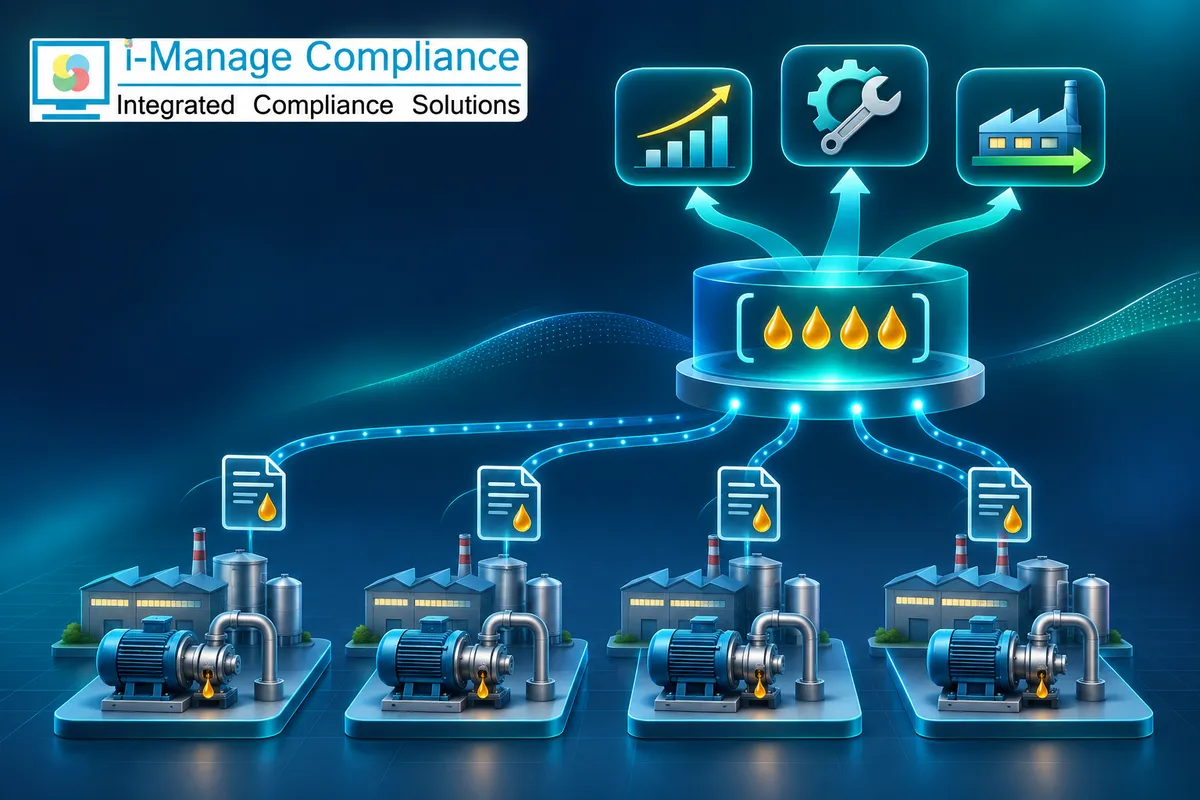
When similar findings recur on the same register, machine model or process across multiple sites, the problem is unlikely to be local. It may point to a design weakness, an inadequate standard, a training gap or an unrealistic procedure. Centralised data makes these organisational patterns visible early enough to intervene.

Trend analysis across sites reveals systemic issues long before they become major events.
4. Data Quality as the Foundation of Insight
No reporting system can compensate for poor data capture. If findings are recorded as “oil on floor”, “machine leaking” or “housekeeping issue” without consistent categories, equipment identifiers or severity ratings, the organisation loses the ability to recognise that these may all relate to a recurring hydraulic leak on a specific machine type.
High-quality HSE data depends on:
Standardised inspection questions and non-conformance categories
Consistent equipment and location references across all sites
Clear guidance on descriptions, severity ratings and action ownership
i-Manage Compliance supports this discipline by structuring how information is captured and linked. That structure enables reliable aggregation and comparison, giving management confidence that reported trends reflect reality rather than inconsistent wording or local spreadsheets.
5. Counts Need Context, Not Assumptions
Raw numbers can be misleading when viewed in isolation. A large distribution centre will naturally report more incidents and findings than a small satellite branch. A site with a mature reporting culture may appear “worse” on paper than a site where issues are seldom recorded at all.
To avoid rewarding low numbers for the wrong reasons, HSE data should be interpreted in relation to:
Exposure measures (hours worked, headcount, production volume, machine numbers)
Severity and potential consequence, not just frequency
Time to close actions and recurrence after closure
Contextualised analysis allows management to differentiate between a high-reporting, well-managed site and a low-reporting, high-risk site. That distinction is essential for credible governance and targeted support.
6. Designing Actionable Management Reports
An effective HSE report should naturally lead to a decision, question or intervention. Instead of presenting only totals, consider structuring reports around:
The top recurring non-conformances by category, site and equipment type
Sites or regions where closure times or recurrence rates are increasing
Links between safety findings and unplanned downtime, quality issues or maintenance spend
Specific support, resources or decisions required from management
In this model, the HSE function is not simply confirming that inspections took place. It is providing structured intelligence that helps executives prioritise investment, adjust maintenance strategies, review supplier performance or address operational bottlenecks before they escalate.
Moving from Records to Decisions with i-Manage Compliance
The number of HSE records stored in your organisation is not, on its own, a measure of control. The real test is whether you can reliably identify patterns across inspections, incidents, actions, equipment and locations — and whether those patterns are visible to the people who make operational and strategic decisions.
i-Manage Compliance is designed to help organisations consolidate and structure HSE and broader compliance information so that authorised users can interrogate it by site, region, asset type, process, category or timeframe. The system provides the framework for analysis and oversight; your teams provide the questions, verification and professional judgement that turn data into action.
If your organisation needs clearer visibility of patterns, stronger accountability for actions, and more useful HSE reporting at management level, the next step is a practical discussion. Explore how structured, centralised information in i-Manage Compliance can support better business decisions, not only safer ones.